
Pipeline
Small molecules, discovered and optimised in-house.
Six programmes across oncology, inflammation and neuroscience. All were originated by the platform and are being optimised by our own chemistry and biology teams.
| Programme | Target class | Indication area | Stage | Origin |
|---|---|---|---|---|
| 1859-1041 | Kinase | Oncology | Lead optimisation | Platform |
| 1859-2087 | GPCR | Inflammation | Lead optimisation | Platform |
| 1859-3012 | Ion channel | Neuroscience | Lead identification | Platform |
| 1859-3044 | Protease | Oncology | Lead identification | Platform |
| 1859-4009 | Undisclosed | Inflammation | Hit expansion | Partner target |
| 1859-5023 | Undisclosed | Neuroscience | Hit expansion | Partner target |
Stages follow standard small molecule nomenclature. Programme identifiers are internal.
How a programme moves
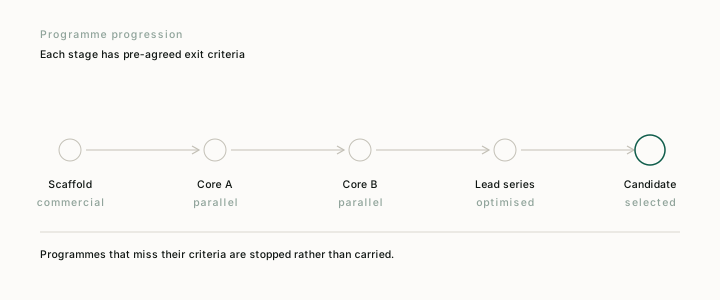
A programme enters the platform as a target hypothesis and a set of assay requirements. The first two cycles are exploratory: broad libraries against the primary assay to establish whether the target is tractable at all. From the third cycle the model has enough signal to design narrower libraries, and chemistry begins to converge on series rather than hits.
Progression between stages is decided by a joint chemistry and biology review against pre-agreed criteria — potency, selectivity, predicted clearance, and synthetic tractability. Programmes that fail are stopped rather than carried.
Partnering
We work with pharmaceutical and biotechnology partners on targets where our platform gives a genuine speed or coverage advantage — typically targets with no existing chemical matter, or where selectivity against a close family is the central problem. Two of our six programmes are partnered.